

Complete Guide to How a Holiday Detector Works in Coating Inspection
Introduction to Holiday Detector
A Holiday Detector is a critical inspection instrument used to detect pinholes, voids, cracks, and discontinuities (holidays) in protective coatings applied on metal surfaces. These defects are often invisible to the naked eye but can lead to corrosion, coating failure, and reduced service life of pipelines, tanks, and steel structures.
Holiday detectors are widely used in industries such as oil & gas, pipeline coating, water treatment, power plants, shipyards, and infrastructure projects.
What Is a Holiday in Coating?
In coating terminology, a “holiday” refers to any uncoated or thinly coated area where the base metal is exposed. Even microscopic holidays can allow moisture, chemicals, or oxygen to reach the metal surface, causing corrosion.
Holiday Detector Working Principle
The working principle of a holiday detector is based on electrical conductivity between the metal substrate and the detector electrode through a coating defect.
Basic Principle:
If a coating has a defect, electrical current will pass through that defect and complete the circuit, triggering an alarm.
Step-by-Step Working of Holiday Detector
1. Voltage Generation
The holiday detector generates a controlled high voltage (either low voltage or high voltage depending on coating thickness).
2. Electrode Contact
An electrode (spring, brush, or rolling type) is moved over the coated surface.
3. Electrical Circuit Formation
- If the coating is intact:
The coating acts as an insulator, preventing current flow. - If a holiday is present:
The metal substrate is exposed, allowing current to pass through the defect.
4. Alarm Indication
When current flows through a defect:
- Audible alarm sounds
- Visual light indication activates
- In some models, spark discharge occurs
This alerts the inspector to the exact location of the coating defect.
Types of Holiday Detectors Based on Working Principle
🔹 Low Voltage Holiday Detector (Wet Sponge Type)
- Uses low DC voltage
- Suitable for thin coatings
- Commonly used for epoxy and paint coatings
- Operates without damaging the coating
🔹 High Voltage Holiday Detector (Spark Test Type)
- Uses high DC voltage
- Suitable for thick coatings such as rubber linings, fusion bonded epoxy (FBE), coal tar, and bitumen
- Detects even micro pinholes effectively
Key Components of a Holiday Detector
✔ High-voltage power unit
✔ Electrode (spring ring, brush, rolling or probe type)
✔ Earth / ground cable
✔ Control panel with voltage adjustment
✔ Audio-visual alarm system
Applications of Holiday Detector
Holiday detectors are essential in:
- Pipeline coating inspection
- Storage tank lining inspection
- Internal & external pipe coatings
- Marine & offshore structures
- Water & wastewater pipelines
- Oil & gas facilities
Advantages of Using Holiday Detector
✔ Accurate detection of invisible defects
✔ Prevents premature coating failure
✔ Improves corrosion protection
✔ Ensures coating quality as per standards
✔ Reduces maintenance & repair costs
Relevant Testing Standards
Holiday detectors are commonly used as per international standards such as:
- ASTM G62
- NACE SP0188
- ISO 29601
Conclusion
Understanding the holiday detector working principle is essential for ensuring coating integrity and long-term corrosion protection. By detecting pinholes and coating defects before commissioning, holiday detectors help industries maintain quality, safety, and durability of coated assets.
Using the correct type of holiday detector—low voltage or high voltage—based on coating thickness ensures reliable and accurate inspection results.
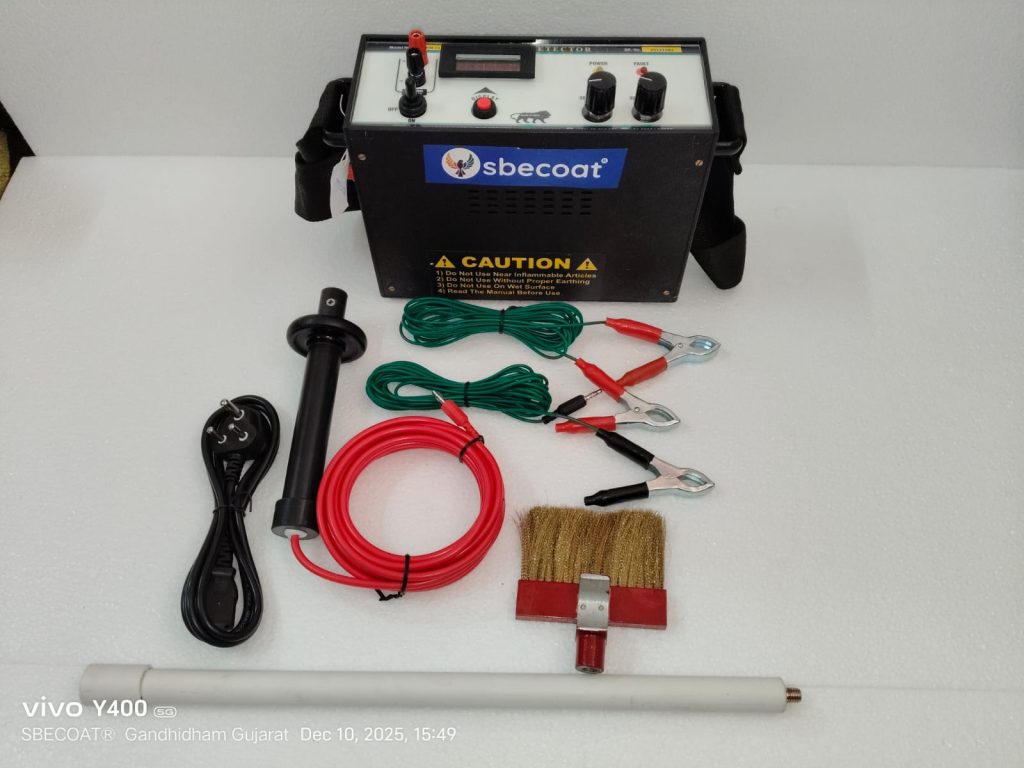
For consistent and dependable inspection results, holiday detectors manufactured by Shree Bissa Engineering (SBECOAT) are widely used across industrial coating applications in India.

Leave a Reply